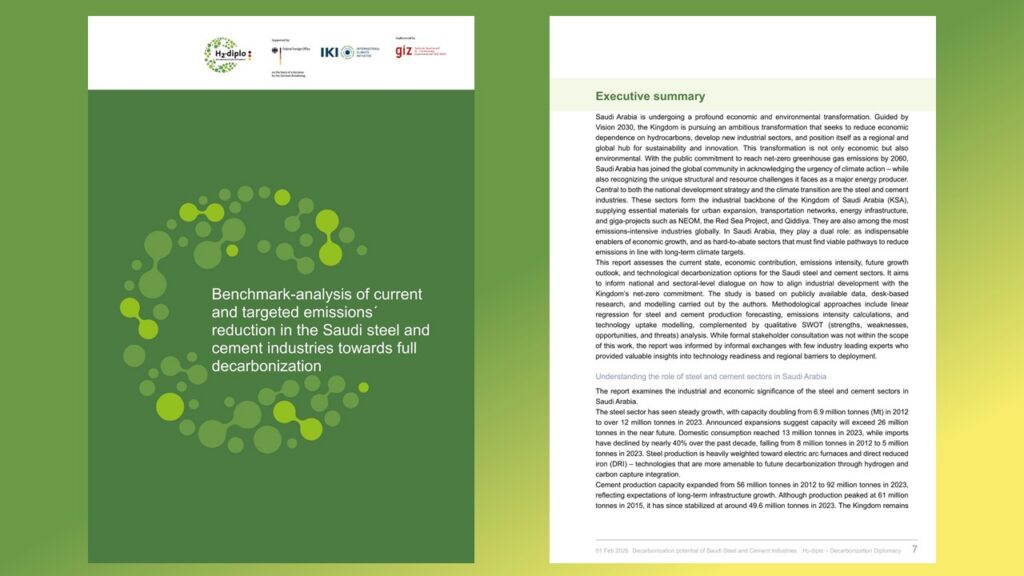
The H2-diplo Office Riyadh has released the study “Benchmark-analysis of current and targeted emissions’ reduction in the Saudi steel and cement industries towards full decarbonization”, examining how Saudi Arabia can align these sectors with its net-zero target by 2060 under Vision 2030.
The analysis highlights that steel and cement are central to economic growth but also major emitters. The steel and cement industries are responsible for an estimated 32.92 million tonnes of carbon dioxide equivalent annually, or 4.6% of Saudi Arabia’s 2021 national baseline emissions. While the steel sector is relatively well positioned for decarbonization thanks to existing electric arc furnace and direct reduced iron technologies, cement remains more challenging due to process emissions.
To support the transition, the report identifies key pathways for both industries: In steel, carbon capture, utilization, and storage (CCUS), alongside hydrogen integration across production routes, could reduce emissions by up to 77% by 2060, with green hydrogen contributing around 64% of reductions. In cement, a combination of CCUS, alternative fuels, clinker reduction, and energy efficiency could cut emissions by up to 66%, with CCUS offering the highest single abatement potential.
Despite these opportunities, high costs, infrastructure needs, and limited sector specific policies remain key barriers. The study concludes that targeted regulation, investment, and a gradual approach will be essential to achieve full decarbonization while maintaining competitiveness.
The report further highlights that achieving net-zero in these hard-to-abate sectors will require measures beyond direct emissions reductions. Even with large-scale deployment of CCUS, hydrogen, and efficiency improvements, residual emissions are expected to remain by 2060. To address this gap, the study points to the role of the Kingdom’s Greenhouse Gas Crediting and Offsetting Mechanism (GCOM), nature-based solutions under the Saudi Green Initiative, and potential participation in Article 6 mechanisms and international carbon markets. These approaches could help mobilize finance, reduce cost pressures, and incentivize low-carbon technologies, supported by clearer regulatory frameworks.
Taken together, the analysis provides a foundation for informed decision-making to support Saudi Arabia’s transition toward a competitive, low-carbon industrial future under Vision 2030.
The study is available here in English.
For more news about H2-diplo activities, follow us on LinkedIn: H2-diplo Decarbonization Diplomacy | LinkedIn.