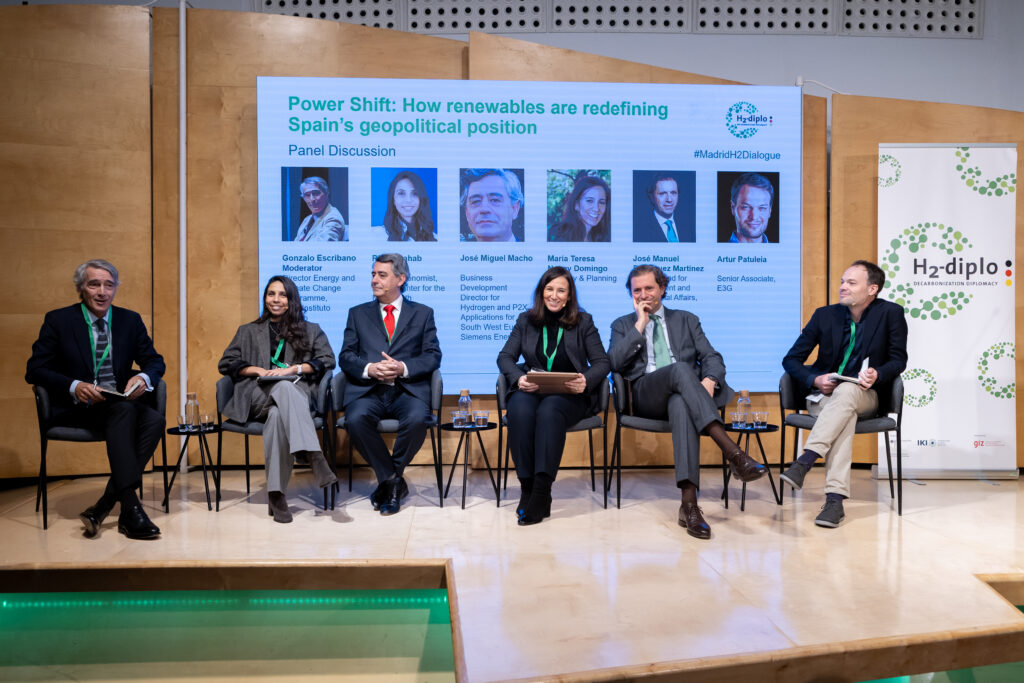
On 11 November 2025, H2-diplo, in collaboration with the Embassy of the Federal Republic of Germany in Madrid and the Real Instituto Elcano, convened the Madrid Decarbonization Dialogue under the theme “Geopolitics Meets Green Transition – The Role of Spain in Europe’s Energy Future.” The event brought together policymakers, researchers, business leaders, and diplomats to examine how Spain’s geographic, industrial, and geopolitical advantages position it as a pivotal actor in Europe’s decarbonisation efforts.
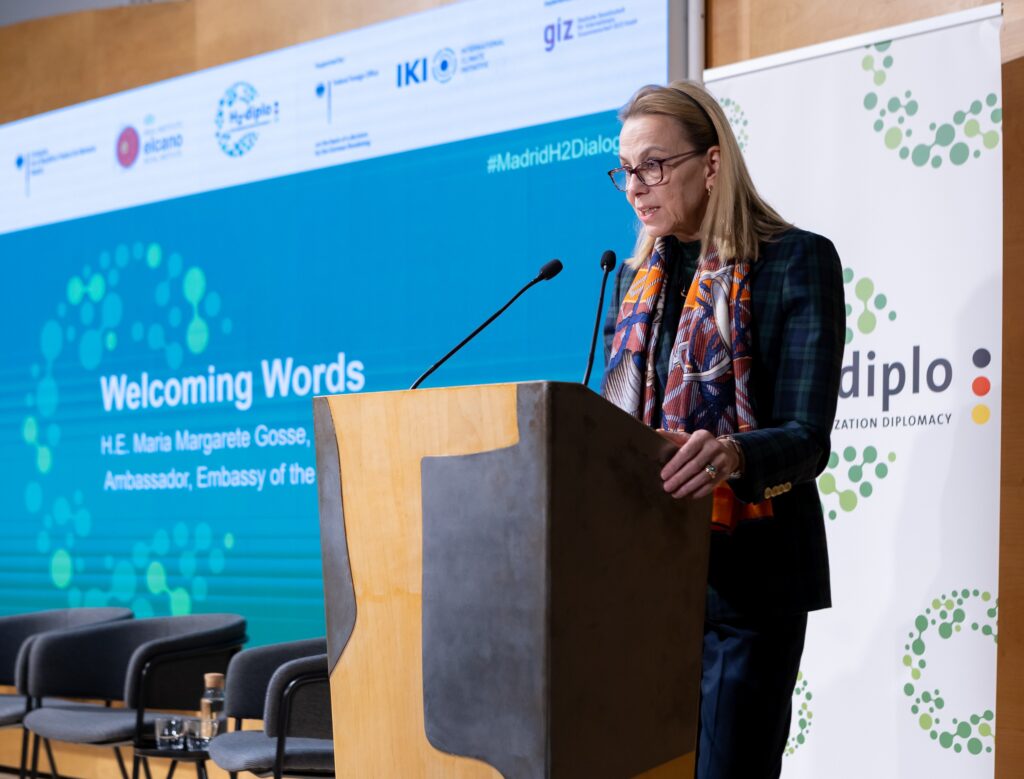
Opening the event, H.E. Maria Margarete Gosse, German Ambassador to Spain, reaffirmed Germany’s enduring commitment to Net Zero, European industrial decarbonisation, and the development of hydrogen technologies and infrastructure. She emphasised that Germany sees its partnership with Spain as central to accelerating the European energy transition, particularly at a moment when energy security, competitiveness, and climate action are increasingly intertwined.
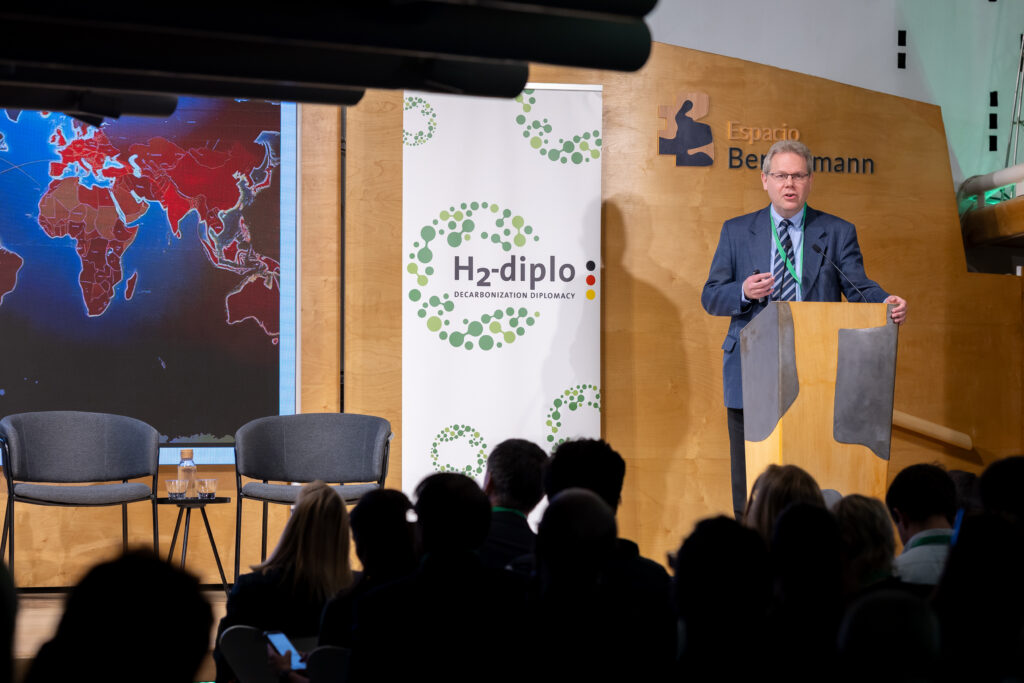
In his keynote, Prof. David Criekemans (University of Antwerp) offered a compelling analysis of how the global energy transition is reshaping geopolitical power and how Spain’s unique assets position it as a major player. Spain’s renewable energy ambitions are among Europe’s most impressive; however, the country’s potential will only be fully realised if several structural challenges are addressed, including grid flexibility deficits and limited storage capacity, cybersecurity considerations, and underdeveloped regional interconnections. The next chapter of Spain’s energy leadership lies in green hydrogen, where the country’s geographic orientation and renewable potential could allow Spain to become a major supplier for Europe.
The centrepiece of the event was the expert panel discussion, which was chaired by Gonzalo Escribano (Real Instituto Elcano), bringing together voices from industry, think tanks, and academia:
Rim Berahab underlined how Spain’s proximity to Morocco is a strategic advantage, but only if it is institutionalised through both hard and soft integration. The existing and planned electrical interconnections could evolve into the backbone of a Euro-Mediterranean energy market, she argued, helping to align market rules, certification schemes, and carbon accounting systems. She identified three levers for deepening cooperation: joint infrastructure development, enabling shared eligibility for European financing instruments, regulatory alignment, without which hydrogen projects will struggle to become bankable, and blended finance.
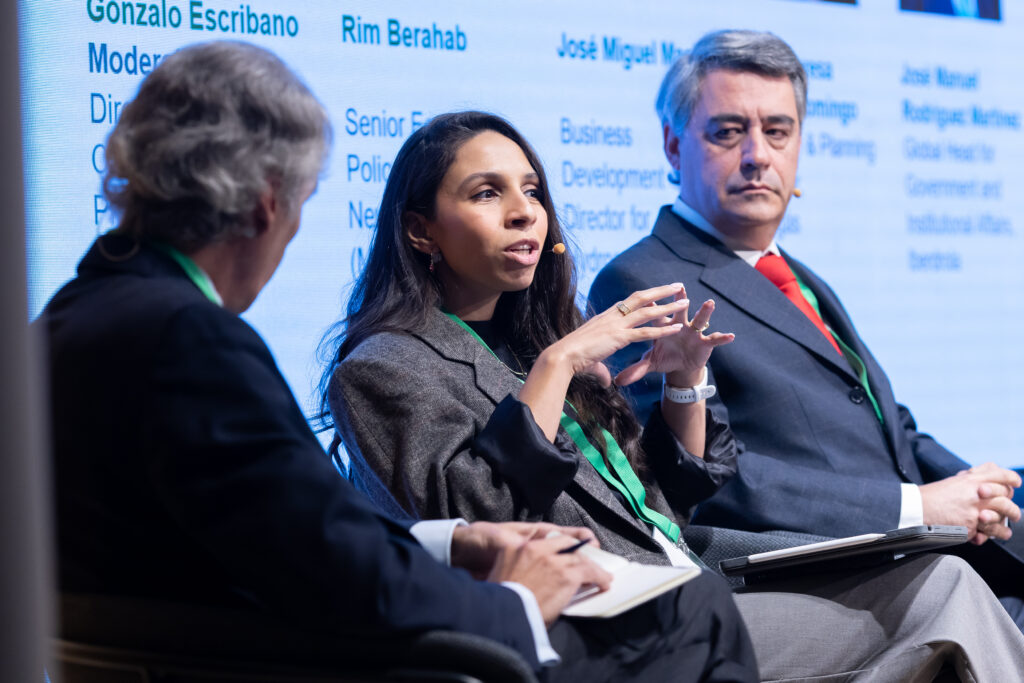
Representing Siemens Energy, José Miguel Macho stressed that energy technologies can only be competitively developed at the European level. Europe remains a global leader in hydrogen technologies, nuclear innovation, and grid infrastructure, but has already lost the race on solar photovoltaics and risks to fall behind on wind power industries. He urged policymakers to treat energy technologies with the same strategic importance as defence or communications infrastructure.
María Teresa Nonay Domingo (Enagás) placed infrastructure at the centre of Europe’s decarbonisation journey. Hydrogen would develop very differently from how natural gas networks developed in Europe, where Europe is building transnational hydrogen corridors from the outset, including the H2Med Corridor connecting Portugal, Spain, France, and Central Europe. She urged European leaders to transpose the Gas and Hydrogen Package into national law, deploy robust de-risking mechanisms for infrastructure investments, align timelines across member states, and ensure clear long-term frameworks to unlock private investment.
For José Manuel Rodríguez Martínez (Iberdrola), Spain’s abundant renewable resources make it highly competitive, offering an opportunity not only to export energy but to re-shore energy-intensive industries, from aluminium to green steel. He highlighted the need to strengthen public–private dialogue to align business decisions with Europe’s strategic autonomy, competitiveness, and climate goals. He also highlighted Spain’s unique ability to build bridges to Latin American partners to diversify European supply chains in the upstream industries, especially on critical raw materials.
Artur Patuleia (E3G) cautioned that hydrogen export should not be a policy goal in itself as greater economic value is created when hydrogen is integrated into domestic industrial processes. Producing green steel in Spain, for example, can generate up to five times the value compared to exporting hydrogen to Northern Europe. Europe should integrate climate and material intensity targets more closely in its decarbonisation and infrastructure planning
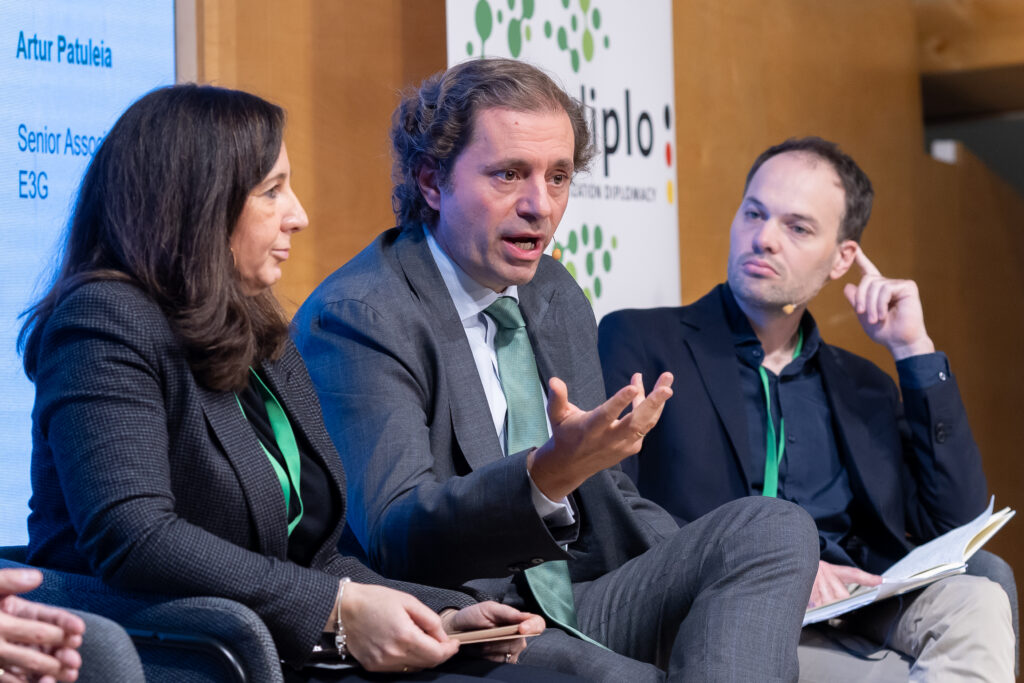
In her closing remarks, María Dolores de Cospedal, Vice Chair of the Real Instituto Elcano, highlighted the strong relations between Germany and Spain, emphasising a promising future of greater cooperation on driving shared ambitions in energy and industrial ambitions forward. She stressed the EU’s single market as its strongest asset, one that should be deepened towards a strong energy union that supports its strive for energy independence.
The Madrid Decarbonization Dialogue underscored a clear conclusion: Spain holds unique leverage in shaping Europe’s energy, industrial, and geopolitical future. But turning potential into impact requires deeper integration, across borders, across sectors, and across the public-private divide.
For more news about the H2-diplo activities, follow us on LinkedIn: H2-diplo – Decarbonization Diplomacy | LinkedIn.
Photo credits: Jesús Antón – Fotógrafo